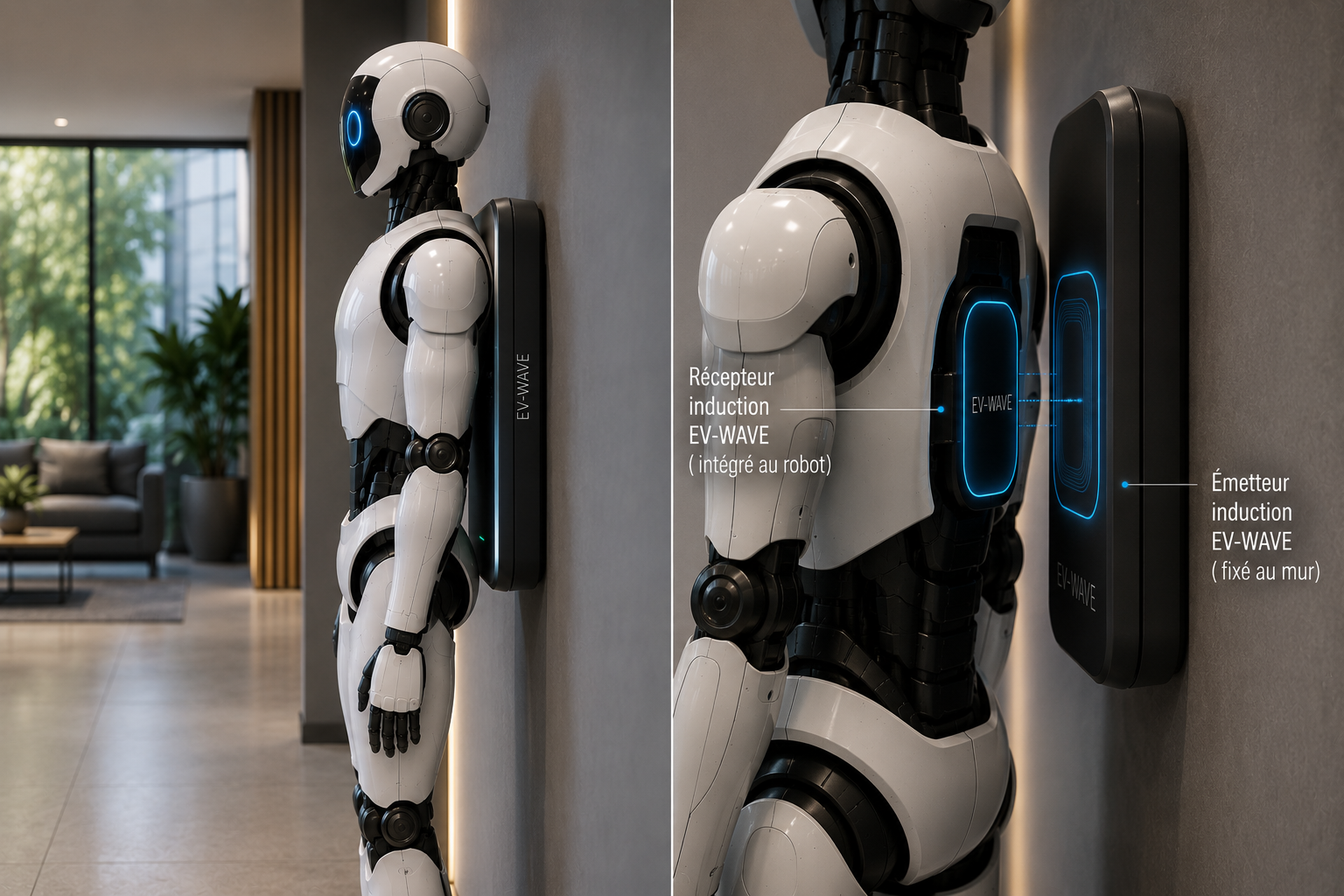
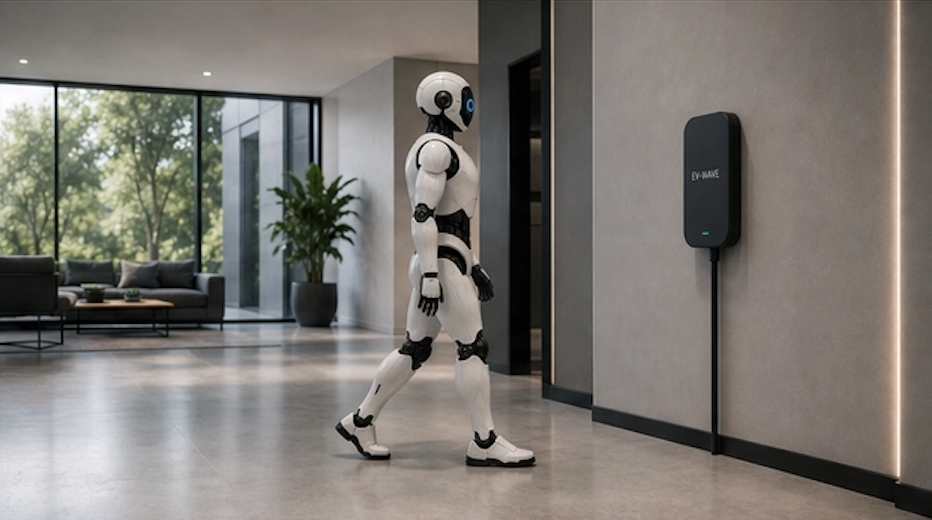
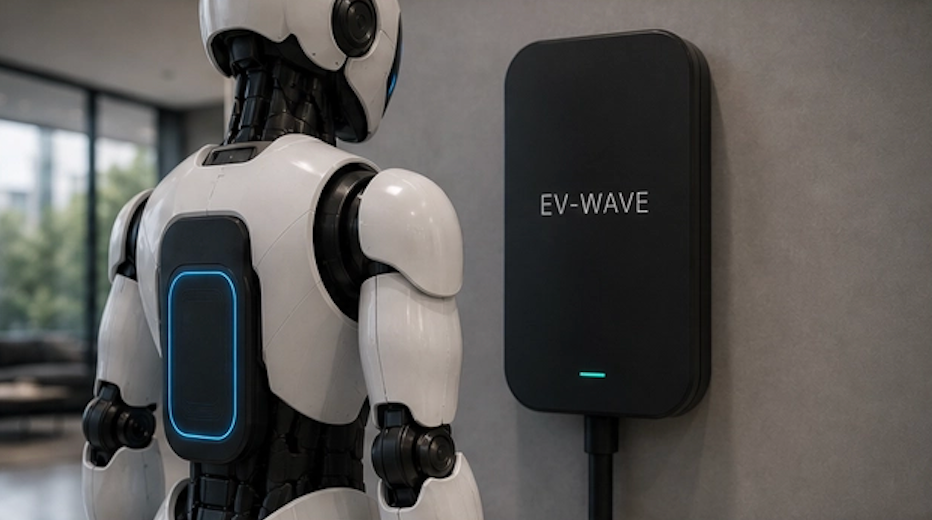
A charging station suited to the posture of bipedal robots.
Humanoid robots are gradually arriving in warehouses and factories for fine handling, picking and inspection tasks. Their charging method must fit their resting posture, with no exposed connector and no plugging-in gesture.
Anticipating an emerging segment.
Unlike an AGV or an AMR, a humanoid robot generally recharges standing up or in a rest position defined by the manufacturer, often in the immediate vicinity of areas where human colleagues operate. Removing exposed electrical contact then becomes a matter of safety as much as of reliability.
The EV-WAVE platform, designed to cover a wide voltage range (10–60 V) and power range (100 W–1.6 kW), adapts to a floor charging base built into the robot's rest station, with no modification to its load-bearing structure.
- Charging base built into the robot's rest station
- No connector exposed near areas shared with operators
- One single platform, compatible with several battery architectures
Tasks where dexterity matters more than speed
Fine picking
Picking irregular or fragile items, complementing AMR systems on high-dexterity tasks.
Mixed human-robot stations
Direct coexistence with operators, where the electrical safety of the charging point becomes a priority criterion.
Quality control
Visual and manual inspection of parts coming off the line, at fixed stations equipped with a charging base.
A shared technology base, not a fixed product.
The same inductive charging architecture underpins all of our robotics applications. For humanoids, it takes the form of a floor rest station, sized together with partner integrators and manufacturers.
| Power | 100 W – 1.6 kW |
|---|---|
| Battery voltage | 10 V – 60 V |
| Target efficiency | 93% |
| Air gap | 1 – 10 cm |
Integrating humanoid robots?
Let's talk about your robotics platform and the charging station best suited to it.